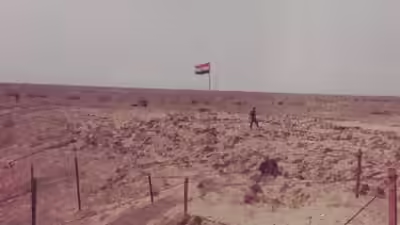
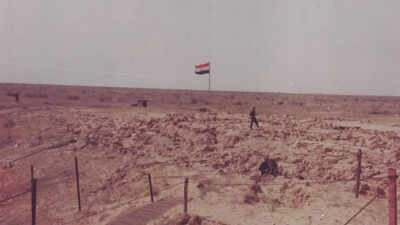
JAISALMER: Can the absence of water in a region ever be considered a blessing? In the case of Khetolai village in Rajasthan’s Jaisalmer district, it certainly proved to be one. The unique geological structure beneath this small desert village earned it a place in history’s golden pages when India conducted the famous Pokhran-II Nuclear Tests on May 11 and 13, 1998.Scientists selected the Khetolai region for the nuclear tests because there was virtually no groundwater thousands of meters beneath the surface. This geological feature was considered ideal for underground nuclear testing, as the presence of flowing groundwater could have increased the risk of radioactive contamination spreading underground. Ironically, while Khetolai itself has almost no groundwater, drinking water for the village is supplied through pipelines from Lathi village located nearly 30 kilometres away.Senior groundwater scientist Dr. Narayan Das Inkhia explained that among Rajasthan’s nearly 33,000 villages, Khetolai stood out because of its exceptional geological characteristics.According to him, the region chosen for the Pokhran-II test series was formed millions of years ago by volcanic lava eruptions, creating volcanic rocks rich in rhyolite formations.These volcanic rocks are formed from extremely fine particles of molten lava. During their formation, almost no empty spaces remain between the particles, making the rocks highly compact and impermeable. As a result, they neither absorb water nor allow underground water flow. Dr. Inkhia described them as “dry rocks,” making them highly suitable for nuclear explosions because radioactive material released after a blast would not seep into groundwater or spread through underground water channels.He said similar volcanic rock deposits are found across several villages in the Pokhran region, including Phalsund, Bhaniyana, Dantal, Ujala, Nananiyai, Thaat, Nachatla and Khetolai. In these regions, groundwater is either extremely scarce or found only at great depths, and even then it is highly saline. The area stretching nearly 50 square kilometres between Bhaniyana and Pokhran has similar geological conditions. In Khetolai itself, there is reportedly no sign of water even beyond depths of 2,000 metres.Dr. Inkhia further noted that India’s first nuclear test conducted on May 18, 1974, at Loharki village in Jaisalmer district was also carried out in a similar dry rock zone.Today, Khetolai has become a place of historical and strategic significance for people across the world. Located just 2.5 kilometres from the nuclear test site inside Asia’s largest field firing range at Pokhran, the village draws visitors, journalists and researchers interested in India’s nuclear history.Whenever outsiders visit the village, local residents proudly recount the story of how five underground explosions shook the world and established India among the select group of nuclear-powered nations.Even today, the nuclear test site remains under strict military security. Access to the location is tightly controlled, and visitors must pass through four heavily guarded security gates along a 3.5-kilometre route leading to the test area. After crossing the Kohinoor Gate and reaching the final point, one can view the historic ground beneath which the powerful nuclear blasts were conducted.The Pokhran-II tests were executed under extraordinary secrecy. Renowned missile scientist and former President of India A. P. J. Abdul Kalam reportedly stayed in the Khetolai Field Firing Range for more than two months under a disguised identity, dressed in Army uniform along with two fellow scientists, to oversee preparations for the mission.The carefully planned secrecy ensured that even major international intelligence agencies, including the Central Intelligence Agency (CIA), failed to detect India’s preparations in advance. The inability to discover the tests beforehand was later considered one of the CIA’s major intelligence failures.For Khetolai, the absence of water ultimately became the very reason it earned an unforgettable place in world history.