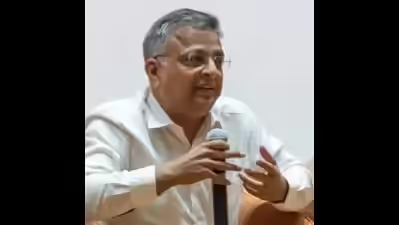

Jaipur: Rajasthan should be cautious about signing long-term power purchase agreements (PPAs) for battery energy storage projects, additional chief secretary Ajitabh Sharma said, warning that poorly designed contracts could erode the flexibility that makes storage valuable.The state is deploying nearly 12,000 MWh of battery storage capacity, with about 3,000 MWh more in the planning stage.“Conventional 25-year PPAs, widely used for plain vanilla solar and wind projects, are now ill-suited for many states. Also, battery systems as storage are not a static asset. Their value evolves with market conditions, grid needs and technology. Hence, 12-25-year contracts for storage must be entered into only after high prudence test,” Sharma said at an event.He said locking tariffs for decades could cap future revenue potential and “unnecessarily burden consumers”.Sharma said battery storage earns from multiple services — such as buying and selling power at different times, grid frequency support and peak demand management — unlike solar plants that mainly generate and sell electricity.“A long-term PPA typically fixes a single revenue stream. That restricts the operator from responding to real-time market opportunities,” he said.He also flagged a mismatch between contract length and battery life. While PPAs often run 20-25 years, most battery technologies operate for 8-15 years, raising questions over replacement costs and long-term performance commitments.“Developers could face financial stress if they are locked into fixed tariffs while incurring midlife reinvestment costs,” he said on the sidelines of Sustainability Impact and Innovation Summit by JU.Sharma pointed to rapid technology shifts in battery chemistry and costs, saying long-duration contracts could lock in today’s assumptions and discourage upgrades.He advocated more flexible procurement, including shorter-term agreements or hybrid structures that allow part of the capacity to participate in open markets, to help developers optimise revenues while supporting grid stability.His comments come as the regulatory framework for storage is still evolving, a situation in which rigid long-term PPAs could prevent projects from benefiting from future policy improvements.